
EMI Shielding Strategies for High-Speed Data Center and Telecom Infrastructure
As data transmission speeds escalate across 100G, 400G, and emerging 800G optical platforms, enclosure-level EMI control has become a primary design constraint. Optical transceivers operate at multi-gigahertz frequencies inside dense rack environments where shielding failures translate directly into signal degradation, radiated emissions, and compliance risk.
In compact pluggable modules such as QSFP-DD and OSFP, mechanical constraints compound the challenge:
- Thin wall aluminum or zinc housings
- Limited clamp force between enclosure halves
- High-density PCB layouts
- Minimal clearance for traditional die-cut gaskets
At these scales, seam-level shielding is not optional. It is fundamental to maintaining signal integrity and passing EMC validation.
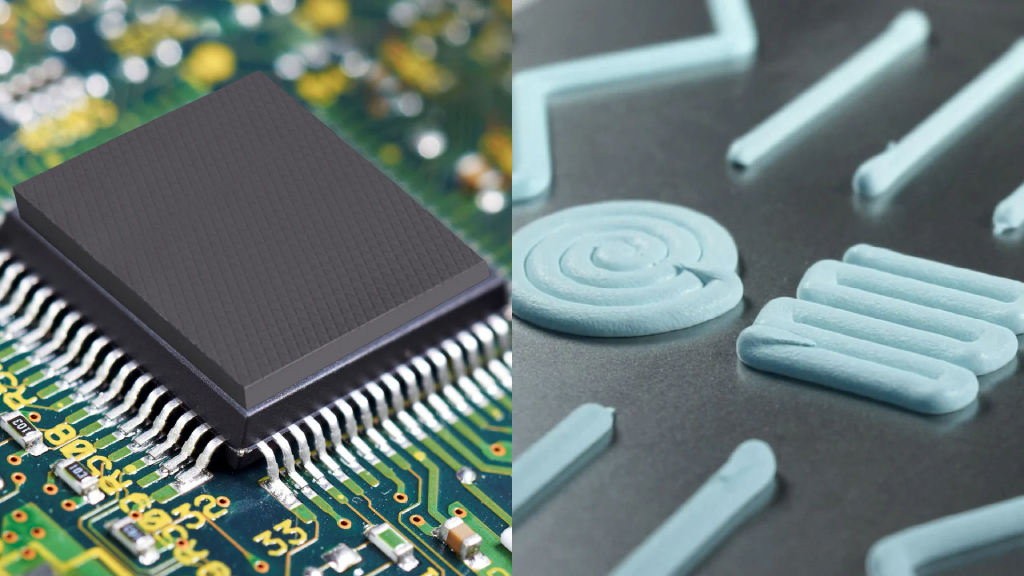
Form-In-Place (FIP) gasket solutions from Matrix Technology provide precision-dispensed EMI shielding that conforms to complex geometries while maintaining low compression force—ideal for optical transceiver applications.
Matrix is Parker Chomerics’ largest distributor in Canada, delivering engineered EMI materials and dispensing expertise for mission-critical electronics.
The EMI Risk in Optical Transceiver Design
Optical transceivers combine:
- High-frequency SerDes and DSP processors
- Metal enclosures and cages
- Fiber optic interfaces
- Power conditioning circuitry
Any discontinuity at enclosure seams can behave like a slot antenna. At high frequencies, even sub-millimeter gaps can:
- Increase radiated emissions
- Introduce cross-channel interference
- Elevate bit error rates
- Cause test failures during EMC certification
Effective EMI shielding must provide:
- Continuous conductive contact
- Controlled compression
- Mechanical compliance
- Long-term environmental stability
Explore broader shielding approaches within the EMI Shielding (HUB).
What Is a Form-In-Place (FIP) EMI Gasket?
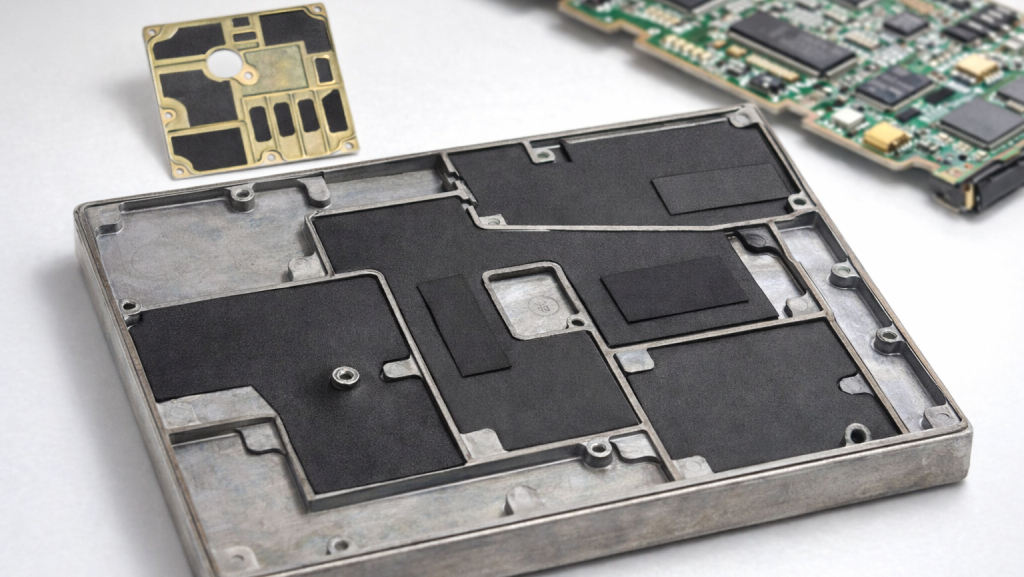
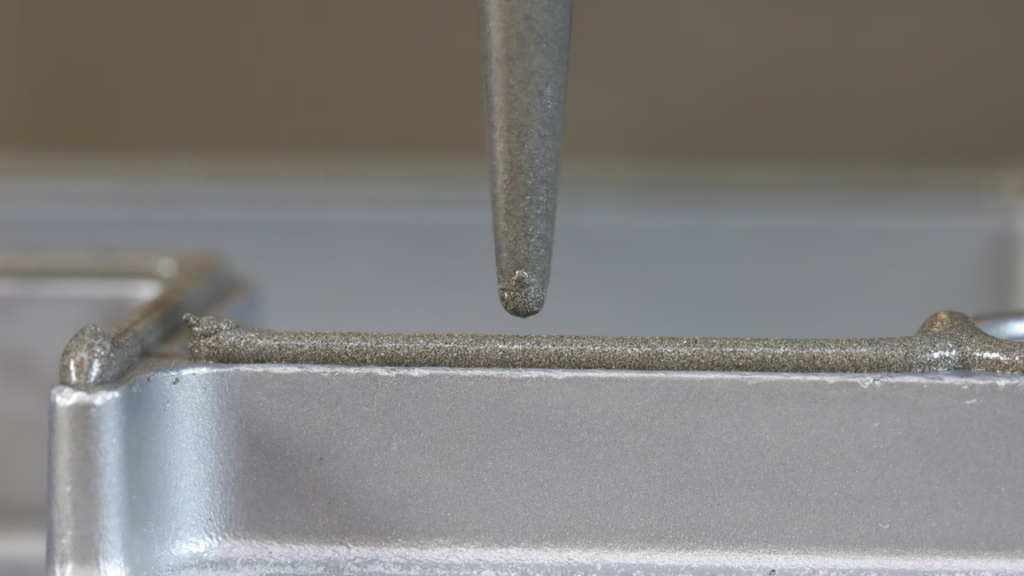
A Form-In-Place gasket is a robotically dispensed conductive elastomer applied directly onto an enclosure flange. After curing, it forms a seamless EMI barrier tailored precisely to the housing geometry.
Matrix provides precision dispensing solutions through our Form-In-Place (FIP) Gaskets platform.
Why FIP Gaskets Are Ideal for Optical Modules
- Accommodate narrow flanges (as small as 0.025 inches)
- Deliver consistent bead placement
- Reduce material waste compared to die-cut formats
- Maintain electrical continuity across complex contours
- Require lower compression force than many traditional gaskets
In thin-wall transceiver housings, compression control is critical. Excessive clamp force risks deforming the enclosure or stressing solder joints.
Parker Chomerics CHO-FORM® 5528 from Matrix Technology
A commonly specified solution in optical and telecom enclosures is Parker Chomerics CHO-FORM® 5528 from Matrix Technology.
CHO-FORM 5528 is a one-component, moisture-cure silicone EMI gasket filled with silver-plated copper particles. Key performance attributes include:
- 70 dB shielding effectiveness
- Low closure force
- Resistivity of approximately 0.005 ohm-cm
- UL 94 V-0 compliant
- 40 Shore A hardness
Because it is moisture cured, CHO-FORM 5528 does not require high-temperature curing to achieve final electrical and mechanical properties. This simplifies manufacturing workflows and supports rapid prototyping.
Why CHO-FORM 5528 Works for Optical Transceivers
Optical modules typically have limited clamping capability due to thin housing walls. CHO-FORM 5528 offers:
- High EMI shielding effectiveness
- High adhesion to common housing substrates
- Low compression requirements
- Dimensional control through programmable dispensing
The result is reliable seam-level EMI containment without structural distortion.
For alternative EMI containment strategies at seams or interfaces, review Shielded Gasket Solutions and Conductive Tapes.
Supporting Signal Integrity in High-Speed Architectures
As PAM4 signaling and high-density interconnects push bandwidth limits, signal integrity margins shrink. EMI leakage and enclosure resonance can:
- Increase jitter
- Degrade eye diagrams
- Interfere with adjacent modules
- Reduce system throughput
FIP gaskets operate in conjunction with:
- Shielded connector interfaces
- Grounding strategies
- RF absorber materials
For cavity resonance control within compact enclosures, see RF Absorbing Solutions.
Environmental and Mechanical Considerations
Beyond EMI containment, optical transceivers deployed in telecom cabinets and edge infrastructure face:
- Thermal cycling
- Humidity exposure
- Vibration
- Mechanical shock
Moisture-cured conductive silicone FIP gaskets provide both:
- EMI shielding continuity
- Environmental sealing performance
For broader sealing strategies, visit the Gaskets (HUB).
Precision Dispensing and Program Support
Successful FIP implementation depends on process control. Matrix supports programs with:
- Fully programmable 3-axis dispensing
- Tight bead size tolerances (±0.001 inch control)
- Automated optical verification
- Prototype-to-production scalability
Learn more about our engineering and converting support on the Capabilities page.
Where optical transceivers integrate into larger ruggedized assemblies, see our Integrated Interconnect & Cable Assembly Solutions overview for system-level alignment.
Frequently Asked Questions About FIP Gaskets for Optical Transceivers
A Form-In-Place gasket provides EMI shielding between enclosure halves, preventing radiated emissions and maintaining signal integrity in high-speed optical modules.
While requirements vary by standard and frequency, shielding effectiveness above 60–70 dB is commonly targeted to maintain EMC compliance and prevent cross-talk in dense rack systems. CHO-FORM 5528 delivers greater than 70 dB shielding performance.
Optical transceiver housings often have thin walls and limited clamp load. High compression force can deform housings, affect alignment, or stress internal PCBs. Low-closure-force FIP materials maintain electrical continuity without mechanical distortion.
Moisture-cure systems eliminate the need for high-temperature curing, simplifying manufacturing and protecting temperature-sensitive components. They also enable rapid prototyping and flexible production workflows.
Yes. Conductive particle-filled silicone FIP gaskets are engineered to provide low impedance continuity across broad frequency ranges typical of high-speed data transmission systems.
High-speed data transmission performance depends on more than optics and silicon. Seam-level EMI control directly impacts signal integrity, EMC compliance, and long-term reliability. Form-In-Place gasket solutions—particularly CHO-FORM® 5528 from Matrix Technology—deliver precise, low-compression EMI containment engineered for the realities of modern optical transceiver design.